
Conclusion
Off the Books revealed that most temporary visa holders work in a labour market where underpayment has become the expected price of a job. Two in three migrant employees were unlawfully underpaid. More than one in three migrants were engaged on an ABN with no employee records. The data revealed that underpayment is not random or isolated: it is part of a broader system of exploitation. The worse the underpayment the more likely the business paid cash, denied superannuation, made wage deductions, and engaged in practices that are indicators of forced labour.
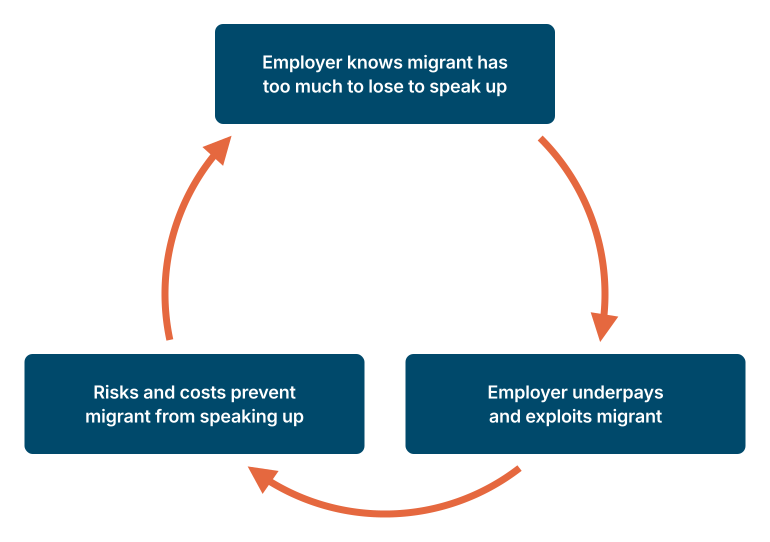
This report shows that the structures that drive migrants’ vulnerability to exploitation also keep those migrants silent when they are underpaid and mistreated at work. As a result, systemic exploitation persists largely undetected.
Of 4,835 participants who knew they had been underpaid, only one in seven (14%) managed to take steps to recover their wages. Only 4% had raised it with a supervisor or their human resource manager. Just 3% had gone to the FWO, even though 59% of underpaid participants indicated they knew about the FWO. Fewer than 1% sought help from a union or community legal centre, and only 17 participants (0.4%) went to court.
The silence was deepest where exploitation was worst. Participants paid under $20 an hour in their lowest paid job were owed an average of $15.40 for every hour they worked, yet they were less likely to have taken steps to address the underpayment than those who were underpaid by less. For regulators and businesses, this means the workplaces with the worst violations are the least likely to generate a complaint.
The survey findings demonstrate that exploited migrants’ silence is not a personal failing. It is a rational response to a system that asks the person with the most to lose to carry the risks of enforcing the law, coupled with the burden of using processes that are complex and unlikely to pay off.
When asked why they would not try to recover the wages they were owed, migrants most commonly selected fear of losing their job. Next came fear for their visa or future immigration pathway, followed by not having access to the information and assistance they needed to lodge a claim. Many saw the process as too complex and unlikely to ultimately compel the employer to pay, especially when their employer had paid them in cash and given them no payslip. Others saw that underpaid peers had acquiesced to exploitation and concluded that underpayment was the norm. Most participants named more than one barrier.
These barriers are structural, and so are the solutions. To fundamentally change employer behaviour, there must be a realistic prospect that employers will face a significant cost to exploiting migrant workers.
In the past two years the Government has introduced new criminal offences for employers that engage in wage theft or coerce migrant workers, along with a register of employers banned from employing migrant workers, and visa protections intended to enable migrants to safely pursue labour claims. The Fair Work Ombudsman has also increased its number of workplace enforcement activities.
These are steps in the right direction, but do not yet amount to the fundamental shifts needed to ensure that employers genuinely fear that exploitation will be detected and serious consequences will flow. The visa protections are accessible to few workers. Only a single business has been placed on the Prohibited Employer Register. The FWO has 251 inspectors for all workplaces in Australia and a budget that is similar to 2024.
While labour enforcement should not principally be driven by worker reports, most government interventions depend on a migrant coming forward with evidence. The survey data reveals that this rarely happens, so the deterrent effect of these reforms is likely limited.
Employers are aware of the laws and difficulties people who aren’t residents/citizens face and know exactly how to exploit them… nothing happens to the employers!
Three broader shifts are needed to disrupt the systemic exploitation of migrants on temporary visas in Australia.
First, it must become rational and safe for migrants to speak up. That means visa protections that are permanent and accessible, and an end to employers controlling access to permanent residence. It means legal help when migrants need it, and accessible wage recovery processes that work even when employers provide no records, disappear or go into liquidation.
Second, enforcement must be scaled up to create a credible expectation of meaningful consequences for noncompliance. The FWO needs resources to enforce the law at the scale the problem demands. FWO’s deterrent impact could be broadened if FWO detection of significant workplace noncompliance routinely resulted in sanctions in the migration domain. This includes use of migration levers such as the Prohibited Employers Register at scale, and preventing access to future migrant sponsorship.
Third, responsibility must be shared. Government holds primary responsibility for labour enforcement, but other actors have power too. Lead firms that profit from migrant labour across their operations and supply chains must be required to conduct due diligence that detects and addresses underpayment, which is a recognised indicator of forced labour. Consideration should be given to Fair Work Act reforms that expand civil accessorial liability for labour noncompliance in a business’ operations and supply chains. Universities and colleges have direct, ongoing relationships with international students, yet have so far done little to support them to avoid and address workplace exploitation. The broader international education sector is well placed to provide critical place-based assistance. Unions, whose members were almost twice as likely to act, need to reach migrant workers in the industries where exploitation is concentrated.
Until these shifts happen, silence will remain the rational choice for most underpaid migrants. Migrants across Australia will be deprived of billions of dollars they have lawfully earned, and wage theft will remain almost cost-free for the businesses that commit it.